Currently Empty: $0.00

How to Choose the Best Email Marketing Service for a Small Business
Introduction
Running a small business today means wearing a dozen different hats at once, and marketing is usually one of the heaviest ones to carry. Among all the marketing channels available, email remains one of the most reliable ways to reach customers directly, build trust over time, and turn casual browsers into repeat buyers. Yet with so many email marketing services on the market, each promising to be the easiest, cheapest, or most powerful option, choosing the right one can feel overwhelming. Small business owners often find themselves stuck comparing feature lists, pricing tiers, and customer reviews without a clear sense of what actually matters for their specific situation. This article walks through everything you need to know to choose the best email marketing service for your small business, from understanding your own needs to comparing features, pricing, and long-term value, so you can make a decision that actually supports your growth instead of adding another confusing tool to your stack.
[Image: A small business owner reviewing email marketing analytics on a laptop]
Table of Contents
- Why Email Marketing Still Matters for Small Businesses
- Understanding Your Business Needs Before You Choose
- Key Features to Look For in an Email Marketing Service
- Pricing Models and Budgeting for Small Businesses
- Comparing Popular Types of Email Marketing Services
- Common Mistakes Small Businesses Make When Choosing an Email Service
- How to Test and Trial a Service Before Committing
- Tips for Getting the Best ROI from Your Email Marketing Service
- Frequently Asked Questions
- Final Thoughts
Why Email Marketing Still Matters for Small Businesses
There is a common misconception that email marketing is outdated, especially with the rise of social media and instant messaging apps. In reality, email remains one of the highest return-on-investment channels available to small businesses. Unlike social media platforms, where algorithms decide who sees your content and organic reach keeps shrinking, email gives you direct access to your audience’s inbox. When someone subscribes to your list, they are giving you permission to speak to them personally, which is a level of access that no social platform can guarantee. This direct line of communication becomes even more valuable for small businesses that do not have large advertising budgets to compete with bigger brands on paid channels. A well-run email list allows a small business to nurture relationships over time, remind customers about products they browsed but did not buy, share updates about new arrivals or seasonal promotions, and build a sense of community around the brand. Every dollar spent on email marketing tends to generate a significantly higher return compared to most other digital marketing channels, which is why so many small business owners continue to invest in building and maintaining their email lists even as new platforms rise and fall in popularity. Choosing the right service to manage this channel is not just a technical decision, it is a decision that directly affects how much revenue your business can generate from the customers who already know and trust you.
Email also gives small businesses something incredibly rare in the digital world: ownership. Your social media followers technically belong to the platform, and if that platform changes its algorithm, gets banned in a region, or simply falls out of favor, you lose access to those people overnight. Your email list, on the other hand, is yours. You can export it, move it to a different service, and keep talking to those subscribers no matter what happens to any single platform. This is why so many marketing experts describe an email list as one of the most valuable digital assets a small business can build, right alongside its website and its reputation.
[Image: Illustration showing email open rates compared to social media reach]
Understanding Your Business Needs Before You Choose
Before comparing specific email marketing services, it helps to take a step back and think honestly about what your business actually needs. Too many small business owners choose a platform based on what a friend recommended or what looked good in an advertisement, without considering whether the tool fits their actual workflow. The first thing to consider is the size of your current or expected email list. A business with a few hundred subscribers has very different needs compared to one that is managing tens of thousands of contacts, and pricing tiers on most platforms scale directly with list size, so this number matters a lot for your budget planning. The second factor is the type of business you run. An online store selling physical products will benefit enormously from a service with strong e-commerce integrations, abandoned cart emails, and product recommendation features, while a local service-based business like a salon or consulting firm might prioritize simple appointment reminders and promotional newsletters instead.
Another important consideration is your comfort level with technology. Some email marketing platforms are built with simplicity in mind, offering drag-and-drop editors and pre-made templates that require no design or coding skills at all. Others are more powerful but come with a steeper learning curve, offering advanced automation builders, custom coding options, and detailed segmentation tools that take time to master. If you are a solo entrepreneur juggling every part of your business yourself, a simpler platform might serve you better even if it has fewer advanced features, because you are more likely to actually use it consistently. On the other hand, if you have a dedicated marketing person or team, investing in a more robust platform with deeper customization could pay off significantly in the long run.
You should also think about how your email marketing fits into your broader business operations. Does your business rely heavily on customer data from other systems, like a customer relationship management tool, an online store platform, or a booking system? If so, the ability of an email service to integrate smoothly with those existing tools becomes a critical factor. A platform that looks appealing on its own but does not connect well with your current systems can end up creating more manual work rather than saving you time. Taking the time to map out these needs before you start comparing services will save you from switching platforms later, which can be a frustrating and time-consuming process once your list has grown and your automations are already built.
[Image: A checklist graphic showing business needs assessment for choosing software]
Key Features to Look For in an Email Marketing Service
Once you have a clear picture of your business needs, the next step is understanding which features actually matter when comparing different platforms. Not every feature will be equally important to every business, but there are several categories worth evaluating carefully before making a final decision.
Ease of Use and Templates
For most small business owners, ease of use is one of the most important factors, simply because time is limited and marketing often gets squeezed between many other responsibilities. A good email marketing service should offer an intuitive editor that lets you create professional-looking emails without needing design experience. Drag-and-drop builders have become the standard in this industry, allowing users to add images, buttons, text blocks, and product listings with simple clicks rather than writing code. Pre-built templates are another valuable feature, especially for businesses that do not have access to a graphic designer. A wide selection of templates for different purposes, such as newsletters, promotional announcements, welcome sequences, and holiday campaigns, can save enormous amounts of time and help maintain a consistent, polished brand image across every email you send.
Automation and Workflows
Automation is where email marketing services truly separate themselves from simply sending a newsletter here and there. A strong automation feature allows you to set up sequences that trigger based on subscriber behavior, such as sending a welcome series to new subscribers, following up with someone who abandoned their shopping cart, or re-engaging customers who have not opened an email in a while. These automated workflows run in the background without requiring constant manual effort, which means your business keeps nurturing relationships with customers even while you are focused on other tasks. For small businesses especially, automation can feel like having an extra team member handling repetitive communication tasks around the clock. When evaluating a service, pay attention to how flexible and easy to build these automations actually are, since some platforms offer only basic triggers while others provide detailed, branching workflows based on multiple conditions.
[Image: A visual workflow diagram showing an automated welcome email sequence]
List Management and Segmentation
As your subscriber list grows, sending the same message to everyone becomes less effective. Segmentation allows you to divide your list into smaller groups based on characteristics like purchase history, location, engagement level, or interests, so you can send more relevant and personalized messages to each group. A good email marketing service should make it easy to create these segments and automatically update them as subscriber behavior changes, rather than requiring manual list management every time. Tagging systems, custom fields, and behavior-based segmentation are all features worth looking for, since they directly impact how relevant your emails feel to the people receiving them, which in turn affects your open rates and overall engagement.
Deliverability and Sender Reputation
One of the most overlooked but genuinely critical factors when choosing an email marketing service is deliverability, meaning how reliably your emails actually reach the inbox rather than getting filtered into spam folders. Even the most beautifully designed email is worthless if it never reaches its intended recipient. Established email marketing platforms typically maintain strong relationships with internet service providers and follow best practices around authentication protocols, which helps protect your sender reputation. Before choosing a service, it is worth researching its general reputation for deliverability, since some lesser-known or budget platforms have historically struggled with higher spam complaint rates that hurt overall inbox placement for their users.
Analytics and Reporting
Understanding how your emails are performing is essential for improving your strategy over time. A solid email marketing service should provide clear analytics on open rates, click-through rates, conversion rates, unsubscribe rates, and revenue generated from campaigns, especially for e-commerce businesses. Beyond basic metrics, look for platforms that offer A/B testing capabilities, allowing you to test different subject lines, send times, or content variations to see what resonates best with your audience. Over time, this data becomes incredibly valuable for refining your messaging and getting better results from every campaign you send.
[Image: Dashboard screenshot mockup showing email campaign analytics]
Integrations with Other Tools
Your email marketing service does not exist in isolation. It needs to work alongside the other tools your business already relies on, such as your website platform, online store, customer relationship management system, or event booking software. Strong integration capabilities mean your customer data flows smoothly between systems, allowing for more accurate segmentation and more personalized automation. Before committing to a platform, check whether it has a direct integration with the specific tools your business uses, or at minimum, whether it connects through a third-party automation service that can bridge the gap.
Customer Support
When something goes wrong with your email campaigns, whether it is a technical glitch, a deliverability issue, or simply confusion about how to use a feature, responsive customer support can make a significant difference. Small business owners often do not have the luxury of waiting days for a response, so it is worth researching what kind of support each platform offers, including live chat, phone support, email tickets, and the availability of a knowledge base or community forum. Reading reviews specifically about customer service experiences can give you a realistic sense of what to expect if you run into trouble down the road.
Pricing Models and Budgeting for Small Businesses
Pricing is often the deciding factor for small businesses choosing between different email marketing services, and understanding how these platforms structure their costs is essential for making a sound financial decision. Most email marketing services use a tiered pricing model based primarily on the number of subscribers on your list, though some also factor in the number of emails sent per month. As your list grows, your monthly cost typically increases, which means it is important to think not just about your current needs but about where your business might be in a year or two.
Many platforms offer a free tier or a free trial period, which can be a great way to test a service before committing financially. Free plans usually come with limitations, such as a cap on the number of subscribers, restricted access to advanced automation features, or the platform’s branding included in your emails. These free options can work well for very early-stage businesses that are just starting to build their list, but they often become limiting fairly quickly as a business grows and needs more sophisticated tools.
Paid plans generally fall into a few common structures. Some services charge based purely on subscriber count, meaning your bill increases automatically as your list grows regardless of how often you actually email them. Others charge based on the volume of emails sent, which can be more cost-effective for businesses with large lists that email infrequently. Some platforms also offer flat-rate pricing with unlimited contacts up to a certain point, which can provide more predictable budgeting for growing businesses. When comparing pricing across different services, it is important to look beyond the advertised starting price and calculate what your actual monthly cost would be based on your realistic subscriber count and sending frequency, since introductory prices often apply only to the smallest list sizes.
It is also worth considering the total cost of ownership rather than just the subscription fee. Some platforms include advanced features like landing pages, forms, and basic customer relationship management tools within their pricing, which could eliminate the need for separate software subscriptions elsewhere. Others charge extra for premium features like advanced automation, additional team member seats, or priority support. Taking the time to map out your actual expected usage against each platform’s pricing structure will give you a much clearer picture of the real cost than simply comparing the headline prices advertised on each company’s website.
[Image: Comparison chart illustrating tiered pricing structures for email marketing platforms]
Comparing Popular Types of Email Marketing Services
Rather than recommending one single service as universally best, since the right choice genuinely depends on your business type and goals, it is more useful to understand the general categories of email marketing services available and which type of business each tends to suit best.
Beginner-friendly, all-in-one platforms are designed for small business owners who want a simple, straightforward experience without a steep learning curve. These platforms typically offer clean drag-and-drop editors, a solid library of templates, and basic automation features that cover the essentials like welcome sequences and simple promotional campaigns. They tend to be budget-friendly at lower subscriber counts and are a great starting point for businesses just beginning to build their email marketing strategy.
E-commerce focused platforms are built specifically with online stores in mind, offering deep integrations with popular shopping cart and store platforms, along with specialized automation for abandoned cart recovery, post-purchase follow-ups, and personalized product recommendations based on browsing and purchase history. These platforms often include detailed revenue attribution reporting, showing exactly how much income each campaign or automation generates, which is incredibly valuable for online retailers trying to justify and optimize their marketing spend.
Advanced automation and marketing platforms cater to businesses that want highly sophisticated, behavior-triggered email sequences with detailed branching logic based on multiple subscriber actions. These platforms often come with a steeper learning curve and higher price points but offer significantly more control and customization for businesses ready to invest heavily in a data-driven marketing strategy.
Content creator and newsletter-focused platforms have grown significantly in popularity, particularly for solopreneurs, bloggers, and businesses built around personal branding. These platforms often emphasize clean, text-based email designs that feel more personal and less like traditional marketing, along with features tailored to monetizing an audience directly through paid newsletter subscriptions.
Budget and free-tier platforms exist for very small businesses or those just starting out, offering generous free plans with basic functionality. These can be a smart starting point, though businesses should be prepared to eventually outgrow the free tier as their list expands and their marketing needs become more sophisticated.
Understanding which category best matches your business type will narrow down your options considerably before you even start comparing specific platforms within that category, making the overall decision process much less overwhelming.
[Image: Icons representing different types of email marketing platforms grouped by business use case]
Common Mistakes Small Businesses Make When Choosing an Email Service
Many small business owners fall into predictable traps when selecting an email marketing service, and being aware of these common mistakes can help you avoid them. One of the most frequent errors is choosing a platform based solely on price without considering whether it actually has the features needed to support future growth. While staying within budget is important, choosing the cheapest option available can sometimes mean sacrificing essential features like reliable deliverability, meaningful automation, or helpful customer support, all of which can end up costing more in lost revenue or wasted time than the money saved on the subscription itself.
Another common mistake is underestimating how quickly a subscriber list can grow, leading to sticker shock when a business suddenly finds itself facing a much higher bill after crossing a pricing tier threshold. It helps to look ahead and choose a platform whose pricing structure remains reasonable even as your list scales, rather than one that becomes financially painful the moment your marketing efforts start succeeding.
Many business owners also make the mistake of ignoring integration compatibility with their existing tools, only to discover later that connecting their email platform to their online store or customer database requires expensive third-party workarounds or manual data entry. Checking integration compatibility before signing up can prevent this frustrating and time-consuming situation.
Overcomplicating the decision is another trap, where business owners spend weeks comparing every possible feature across a dozen platforms instead of simply choosing a solid, reputable option that meets their core needs and getting started. Email marketing services generally allow you to export your data and switch platforms later if needed, so the decision does not have to be permanent, and it is often better to start building your list and sending emails sooner rather than perfecting the platform choice for an extended period.
Finally, some small businesses fail to properly test a platform’s deliverability and support quality before fully committing, relying instead solely on marketing claims from the company itself. Taking the time to read independent reviews and test the platform firsthand during a trial period can reveal issues that would not otherwise be apparent until after you have already invested significant time building your campaigns and automations.
How to Test and Trial a Service Before Committing
Most reputable email marketing services offer either a free trial period or a free tier with limited features, and taking full advantage of this testing phase before committing to a paid plan is one of the smartest steps a small business owner can take. During a trial period, it is worth actually building out a real campaign or automation sequence rather than just clicking through the interface superficially. This gives you a genuine sense of how intuitive the platform feels for the specific tasks you will be doing regularly, rather than relying on a general impression from browsing the marketing website.
It is also worth testing the platform’s customer support during the trial by reaching out with a genuine question, whether through live chat, email, or a help center search, to gauge response time and helpfulness. Sending test emails to yourself and colleagues, checking how they render on different devices and email clients, and reviewing the platform’s reporting dashboard after a small test campaign can all reveal important details that are not obvious from a feature comparison chart alone.
If your business relies on specific integrations, testing those connections directly during the trial period is essential rather than assuming they will work smoothly based on the company’s claims. Import a small sample of your actual contact list if possible, and walk through the process of setting up a basic automation from start to finish. This hands-on approach during the trial phase will give you far more confidence in your final decision than simply reading feature lists and pricing pages, and it significantly reduces the risk of committing to a platform that looks great on paper but does not actually fit your day-to-day workflow.
[Image: A person testing an email campaign preview on both desktop and mobile devices]
Tips for Getting the Best ROI from Your Email Marketing Service
Choosing the right platform is only the first step, and getting real value from your investment depends heavily on how you actually use it. Building a quality email list organically, rather than purchasing contact lists, is essential for maintaining good deliverability and genuine engagement, since purchased lists typically contain uninterested recipients who are more likely to mark your emails as spam. Focusing on consistent, valuable content rather than purely promotional messages helps keep subscribers engaged over the long term, since an email list that only receives sales pitches tends to see declining open rates and rising unsubscribe rates over time.
Segmenting your audience and personalizing your messages based on their interests or behavior significantly improves engagement compared to sending identical content to your entire list. Taking advantage of automation features to nurture new subscribers through a welcome sequence, follow up with customers after a purchase, and re-engage inactive subscribers can generate meaningful revenue with minimal ongoing manual effort once the sequences are properly set up.
Regularly reviewing your analytics and testing different subject lines, send times, and content formats allows you to continuously improve your results rather than relying on guesswork. Cleaning your list periodically by removing consistently inactive subscribers, while it might seem counterintuitive to reduce your list size, actually improves your deliverability and engagement metrics, since email providers pay close attention to how recipients interact with your messages when determining whether to place your future emails in the inbox or the spam folder. Treating your email marketing service as an ongoing part of your business strategy, rather than a set-it-and-forget-it tool, is ultimately what separates small businesses that see strong returns from their email marketing from those that let their subscription go underutilized.
Frequently Asked Questions
What is the best email marketing service for a small business just starting out?
For businesses just starting to build their email list, a beginner-friendly platform with an easy-to-use editor, helpful templates, and a generous free or low-cost tier is usually the best starting point, since it allows you to build the habit of consistent emailing without a steep learning curve or high upfront cost.
How much should a small business expect to pay for email marketing software?
Costs vary widely depending on list size and features needed, but many small businesses can expect to pay anywhere from nothing on a free tier for very small lists up to a modest monthly fee that scales as their subscriber count and feature needs grow.
Do I need e-commerce specific features if I don’t run an online store?
No, e-commerce specific features like abandoned cart automation and product recommendations are primarily valuable for online retailers, so a service-based business can typically prioritize other features like appointment reminders, newsletters, and general automation instead.
Can I switch email marketing services later if I outgrow my first choice?
Yes, most platforms allow you to export your subscriber list and campaign content, making it possible to migrate to a different service later, though rebuilding automations and integrations on a new platform does take some time and effort.
How important is deliverability compared to other features?
Deliverability is extremely important because even the best-designed email campaign is ineffective if it lands in the spam folder rather than the inbox, so it should be a key consideration alongside features like automation and ease of use.
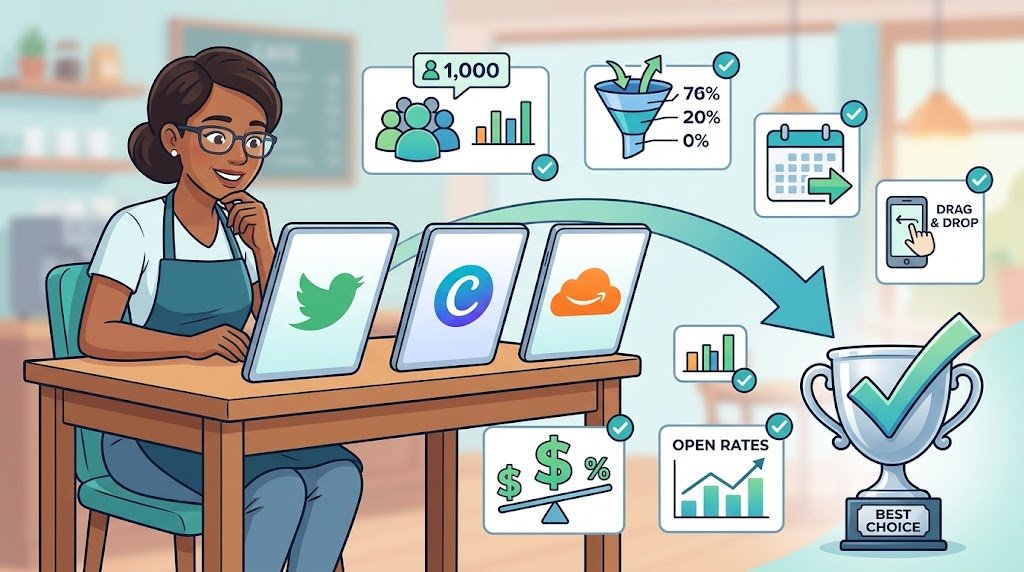
[Image: FAQ section graphic with a small business owner reading on a tablet]
Final Thoughts
Choosing the best email marketing service for your small business ultimately comes down to understanding your specific needs, evaluating the features that matter most for your type of business, and being realistic about your budget both now and as your list grows in the future. There is no single platform that works best for every business, which is why taking the time to assess your priorities, test a few options through their free trials, and read genuine user reviews will lead you to a far better decision than simply choosing the most popular or heavily advertised name on the market. Email marketing remains one of the most valuable tools available to small businesses, offering direct access to your audience, strong potential return on investment, and complete ownership over your customer relationships in a way that other marketing channels simply cannot match. By approaching your decision thoughtfully and focusing on the features and pricing structure that truly align with your business goals, you will set yourself up for a long-term email marketing strategy that genuinely supports your growth rather than becoming just another underused subscription on your monthly expense list.